.svg)
.jpg)

A generous 401(k) match can quietly accelerate your path to retirement. In 2026, many top employers—particularly in tech and finance—continue to enhance their retirement benefits to recruit and retain high-caliber talent. But not all matches are created equal.
At Snider Financial Group, we guide high-income professionals, business owners, and executives through wealth strategies that extend beyond salary. One of the most overlooked yet impactful tools? Employer-sponsored 401(k) matching programs.
In this article, we’ll explore which companies are offering standout 401(k) matches in 2026, what to watch out for, and how you can leverage this benefit for long-term retirement growth.
A 401(k) match is essentially free money—when you contribute to your retirement, your employer matches a percentage, amplifying your savings without increasing your tax burden today.
Let’s break it down:
If your employer matches 6% on a $200,000 salary, and you contribute at least $12,000, your company may contribute an additional $12,000—resulting in $24,000 toward your retirement that year. Over 10 years, assuming 6% annual growth, that match alone could grow to over $158,000.*
For affluent earners, maxing out 401(k) contributions—especially with a strong match—is a foundational strategy in reducing taxable income and building a tax-advantaged retirement portfolio.
Below is a snapshot of standout companies offering top-tier 401(k) matches in 2026 (based on publicly available benefits data as of January 2026):
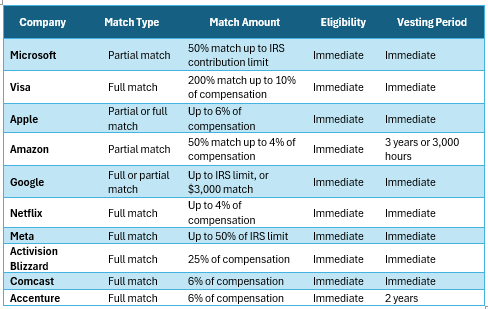
Standout examples:
This is non-negotiable. Even if you’re focused on paying down student debt or investing elsewhere, failing to contribute at least up to the match threshold is leaving free money on the table.
Example:
If your company matches 5% and you only contribute 3%, you’re missing out on thousands annually in match dollars—plus compounding returns.
Some companies offer immediate vesting (you keep employer contributions no matter when you leave). Others may require 2–3 years of service. If you leave before fully vesting, you forfeit some or all of those matched dollars.
Pro tip:
Use vesting timelines to guide career transitions. If a better offer is on the table, factor in how much of your employer’s contributions are vested before jumping ship.
Depending on your current income and future tax outlook, you may benefit from:
Check with HR or your 401(k) administrator to see if your plan supports mega backdoor Roths—a strategy high-income earners can use to save beyond the standard limits.
Once you’re contributing, don’t overlook where those dollars are invested. A diversified, goal-aligned allocation ensures you’re not just saving—but growing your wealth.
Example:
A 45-year-old tech executive in Bellevue with a 20-year time horizon may choose a growth-tilted portfolio inside their 401(k), while simultaneously holding more conservative assets in a taxable account for near-term needs.
Your company’s total compensation package includes more than just the 401(k). Be sure to evaluate:
These can be leveraged in tandem with your 401(k) to form a more holistic and tax-efficient wealth strategy.
For high-income professionals, a 401(k) isn’t just a retirement tool—it’s a strategic wealth-building vehicle. But maximizing its value requires more than simply enrolling in the plan.
From selecting the right contribution type to navigating employer matches and long-term investment choices, a 401(k) strategy aligned with your life and goals can add six figures—or more—to your retirement readiness.
At Snider Financial Group, we help you optimize all facets of your financial life—from evaluating employer benefits to coordinating tax strategies and planning for generational wealth.
Need Help Navigating Your 401(k) or Planning for Retirement?
Let’s review your plan and create a personalized strategy to maximize your employer match, manage risk, and align your savings with your goals.
📅 Schedule a complimentary consultation with Snider Financial Group today.
Sources:
Important Disclosures:
The opinions voiced in this material are for general information only and are not intended to provide specific advice or recommendations for any individual. To determine which investment(s) may be appropriate for you, consult your financial professional prior to investing. Investing involves risks including possible loss of principal. No investment strategy or risk management technique can guarantee return or eliminate risk in all market environments. There is no guarantee that a diversified portfolio will enhance overall returns or outperform a non-diversified portfolio. Diversification does not protect against market risk. This information is not intended to be a substitute for specific individualized tax or legal advice. We suggest that you discuss your specific situation with a qualified tax or legal advisor.

.jpg)
.jpg)